$€¥QUANTUM$€¥
QUANTUM White Paper
My Name: Nguyenduytoan061186
Gmail: Nguyenduytoan061186@gmail.com
WHITEPAPER // 2026
Quantum-Safe Digital Currency and
Tokenization Infrastructure
MAXWELL DENEGA
FOUNDER & CEO
QUANTUM CHAINEXECUTIVE SUMMARY
The global financial system is entering a period of unavoidable structural change.
Advances in quantum computing, escalating regulatory requirements and the
emergence of digital forms of money are converging to expose fundamental
weaknesses in existing financial messaging, settlement and trust frameworks.
Most current financial infrastructure - including interbank messaging systems,
payment APIs, cryptographic key management and digital asset platforms - relies on
cryptographic standards that were not designed to withstand large-scale quantum
computing. At the same time, regulators are demanding higher standards of
auditability, real-time supervision and compliance enforcement across cross-border
payments, stablecoins and tokenised financial instruments.
Quantum Chain has been developed to address these challenges directly.
Quantum Chain is a post-quantum secure financial infrastructure designed for the
issuance, settlement and governance of regulated digital money, including quantum-
safe stablecoins, tokenised deposits, virtual/digital assets and institutional
settlement rails. It provides cryptographic longevity, deterministic settlement finality
and protocol-embedded compliance for financial institutions and sovereign systems.
The platform is designed explicitly for:
Central banks and monetary authorities
Licensed banks and electronic money institutions
Payment networks, PSPs and financial market infrastructure
Regulated issuers of stablecoins and tokenised money
Quantum Chain is not simply a consumer blockchain, not a DeFi platform and not a
speculative Layer-1 network. It is a controlled, permissioned, regulator-aligned
infrastructure intended to coexist with - and progressively modernise - existing
financial systems for the future.1 | THE STRUCTURAL PROBLEM FACING GLOBAL
FINANCE
1.1 Cryptographic Longevity Risk
Modern financial systems depend on public-key cryptography for:
Secure financial messaging
API authentication
Digital identity and signing
Settlement finality and reconciliation
Most deployed cryptographic schemes (RSA, ECC) are vulnerable to sufficiently
powerful quantum computers. This risk is not theoretical. Financial infrastructure has
long operational lifecycles, often exceeding 20–30 years, while cryptographic
compromise can occur instantaneously once capability thresholds are crossed.
The consequence of cryptographic failure in financial systems is not limited to data
breaches. It undermines:
Transaction integrity and Settlement Finality
Legal enforceability
Confidence in digital money
1.2 Regulatory Escalation and Digital Money
Regulators globally are converging on higher standards for:
ISO20022-native financial messaging
Real-time transaction monitoring
Audit-first system design
Stablecoin and tokenised deposit oversight
At the same time, digital money is fragmenting across:
Privately issued stablecoins
Tokenised bank deposits
Wholesale and retail CBDC pilots
Without a common, regulator-grade settlement and governance layer, this
fragmentation increases systemic risk rather than reducing it.
1.3 The Limits of Incremental Upgrades
Incremental upgrades to legacy systems — including overlays, messaging extensions,
or cryptographic patching — do not resolve:
Post-quantum cryptographic risk
End-to-end auditability
Digital money issuance governance
A new class of infrastructure is required.2 | WHAT QUANTUM CHAIN IS
Quantum Chain is a post-quantum secure digital money and settlement
infrastructure comprising four tightly integrated layers:
1.Quantum-secure financial messaging (L0)
2.Deterministic settlement ledger (L1)
3.Protocol-embedded compliance and supervision
4.Regulated digital money issuance framework
Each layer is designed to operate independently but gains full value when deployed as
an integrated stack.
3 | QUANTUM SECURE FINANCIAL MESSAGING (L0)
The messaging layer provides:
ISO20022-native message structures
Post-quantum secure signing and verification
Tamper-resistant message ordering and integrity
This layer is designed to:
Replace or complement legacy interbank messaging
Secure payment, FX, and settlement instructions
Provide cryptographic longevity for regulated financial communication
The messaging layer is institution-to-institution and does not expose consumer
endpoints.4 | SETTLEMENT INFRASTRUCTURE (L1)
The Quantum Chain settlement layer provides:
Deterministic settlement finality
Permissioned validator governance (PoA)
Jurisdiction-aware ledger partitioning
Settlement is:
Asset-agnostic (fiat-referenced, tokenised deposits, CBDCs)
Fully auditable
Designed for integration with RTGS and correspondent systems
Quantum Chain does not mandate on-chain custody of all assets. Instead, it acts as a
settlement and trust coordination layer, aligning on-chain state with regulated off-
chain controls where required.5 | QUANTUM-SAFE DIGITAL MONEY (Q-STABLE
FRAMEWORK)
5.1 Design Principles
Quantum Chain introduces a framework for quantum-safe, regulated stablecoins (“Q-
Stables”), designed to meet institutional and sovereign requirements.
Key principles:
Issued only by licensed entities
Fully reserve-backed
Jurisdiction-specific
Protocol-enforced issuance and redemption rules
Examples include:
QUSD
QSGD
QEUR
QBHD
QJPY
5.2 Why Quantum Safety Matters for Stablecoins
Stablecoins represent long-dated financial liabilities. Unlike speculative crypto-
assets, they function as:
Settlement instruments
Treasury assets
Payment balances
A cryptographic compromise of stablecoin infrastructure undermines:
Monetary trust and Systemic stability
Regulatory confidence
Quantum Chain ensures:
Post-quantum cryptographic survivability
Immutable auditability
Regulator-visible issuance and flow controls
5.3 Issuance & Governance Model
Issuance is governed by:
Licensed issuer controls
Protocol-enforced mint/burn rules
Real-time auditability
Emergency controls and circuit breakers
Quantum Chain does not custody reserves. Reserve custody remains with regulated
financial institutions, preserving existing legal and supervisory frameworks.6 | EMBEDDED COMPLIANCE AND SUPERVISION
Compliance is enforced at protocol level, not via external tooling.
Capabilities include:
AML and sanctions logic prior to settlement
ISO20022 schema enforcement
Jurisdiction-specific regulatory rules
Immutable supervisory audit trails
This architecture allows:
Real-time regulatory visibility
Reduced manual reconciliation
Faster regulatory approvals
7 | GOVERNANCE, CONTROL AND RISK
MANAGEMENT
Quantum Chain employs:
Permissioned validator governance
Institutional onboarding controls
Segregated jurisdictional environments
Formal upgrade and change management processes
Emergency controls exist to:
Pause issuance
Freeze settlement flows (where legally mandated)
Support regulatory intervention
These controls are transparent, auditable, and constrained by governance rules.8 | DEPLOYMENT MODELS
Quantum Chain supports multiple deployment models:
8.1 Sovereign / Central Bank
Wholesale CBDC settlement
National payment modernisation
Cross-border sovereign corridors
8.2 Bank & EMI Issuance
Stablecoins
Tokenised deposits
Treasury settlement
8.3 Payment Networks
Merchant settlement
Cross-border PSP flows
Liquidity optimisation
9 | COMMERCIAL MODEL (HIGH-LEVEL)
Revenue is derived from:
Infrastructure licensing
Issuance and settlement rails
Institutional integration services
Ongoing compliance and governance support
Quantum Chain does not rely on consumer transaction fees or speculative token
dynamics.10 | CURRENT STATUS AND ROADMAP
Live
Core protocol
Messaging and settlement infrastructure
Compliance framework
In Pilot / Sandbox
Stablecoin issuance programs
Sovereign and institutional settlement pilots
Planned (Subject to Regulatory Approval)
Expanded cross-border corridors
Tokenised deposit frameworks
Multi-jurisdiction supervisory interfaces
11 | CONCLUSION
WHITEPAPER // 2026
Quantum-Safe Digital Currency and
Tokenization Infrastructure
MAXWELL DENEGA
FOUNDER & CEO
QUANTUM CHAINEXECUTIVE SUMMARY
The global financial system is entering a period of unavoidable structural change.
Advances in quantum computing, escalating regulatory requirements and the
emergence of digital forms of money are converging to expose fundamental
weaknesses in existing financial messaging, settlement and trust frameworks.
Most current financial infrastructure - including interbank messaging systems,
payment APIs, cryptographic key management and digital asset platforms - relies on
cryptographic standards that were not designed to withstand large-scale quantum
computing. At the same time, regulators are demanding higher standards of
auditability, real-time supervision and compliance enforcement across cross-border
payments, stablecoins and tokenised financial instruments.
Quantum Chain has been developed to address these challenges directly.
Quantum Chain is a post-quantum secure financial infrastructure designed for the
issuance, settlement and governance of regulated digital money, including quantum-
safe stablecoins, tokenised deposits, virtual/digital assets and institutional
settlement rails. It provides cryptographic longevity, deterministic settlement finality
and protocol-embedded compliance for financial institutions and sovereign systems.
The platform is designed explicitly for:
Central banks and monetary authorities
Licensed banks and electronic money institutions
Payment networks, PSPs and financial market infrastructure
Regulated issuers of stablecoins and tokenised money
Quantum Chain is not simply a consumer blockchain, not a DeFi platform and not a
speculative Layer-1 network. It is a controlled, permissioned, regulator-aligned
infrastructure intended to coexist with - and progressively modernise - existing
financial systems for the future.1 | THE STRUCTURAL PROBLEM FACING GLOBAL
FINANCE
1.1 Cryptographic Longevity Risk
Modern financial systems depend on public-key cryptography for:
Secure financial messaging
API authentication
Digital identity and signing
Settlement finality and reconciliation
Most deployed cryptographic schemes (RSA, ECC) are vulnerable to sufficiently
powerful quantum computers. This risk is not theoretical. Financial infrastructure has
long operational lifecycles, often exceeding 20–30 years, while cryptographic
compromise can occur instantaneously once capability thresholds are crossed.
The consequence of cryptographic failure in financial systems is not limited to data
breaches. It undermines:
Transaction integrity and Settlement Finality
Legal enforceability
Confidence in digital money
1.2 Regulatory Escalation and Digital Money
Regulators globally are converging on higher standards for:
ISO20022-native financial messaging
Real-time transaction monitoring
Audit-first system design
Stablecoin and tokenised deposit oversight
At the same time, digital money is fragmenting across:
Privately issued stablecoins
Tokenised bank deposits
Wholesale and retail CBDC pilots
Without a common, regulator-grade settlement and governance layer, this
fragmentation increases systemic risk rather than reducing it.
1.3 The Limits of Incremental Upgrades
Incremental upgrades to legacy systems — including overlays, messaging extensions,
or cryptographic patching — do not resolve:
Post-quantum cryptographic risk
End-to-end auditability
Digital money issuance governance
A new class of infrastructure is required.2 | WHAT QUANTUM CHAIN IS
Quantum Chain is a post-quantum secure digital money and settlement
infrastructure comprising four tightly integrated layers:
1.Quantum-secure financial messaging (L0)
2.Deterministic settlement ledger (L1)
3.Protocol-embedded compliance and supervision
4.Regulated digital money issuance framework
Each layer is designed to operate independently but gains full value when deployed as
an integrated stack.
3 | QUANTUM SECURE FINANCIAL MESSAGING (L0)
The messaging layer provides:
ISO20022-native message structures
Post-quantum secure signing and verification
Tamper-resistant message ordering and integrity
This layer is designed to:
Replace or complement legacy interbank messaging
Secure payment, FX, and settlement instructions
Provide cryptographic longevity for regulated financial communication
The messaging layer is institution-to-institution and does not expose consumer
endpoints.4 | SETTLEMENT INFRASTRUCTURE (L1)
The Quantum Chain settlement layer provides:
Deterministic settlement finality
Permissioned validator governance (PoA)
Jurisdiction-aware ledger partitioning
Settlement is:
Asset-agnostic (fiat-referenced, tokenised deposits, CBDCs)
Fully auditable
Designed for integration with RTGS and correspondent systems
Quantum Chain does not mandate on-chain custody of all assets. Instead, it acts as a
settlement and trust coordination layer, aligning on-chain state with regulated off-
chain controls where required.5 | QUANTUM-SAFE DIGITAL MONEY (Q-STABLE
FRAMEWORK)
5.1 Design Principles
Quantum Chain introduces a framework for quantum-safe, regulated stablecoins (“Q-
Stables”), designed to meet institutional and sovereign requirements.
Key principles:
Issued only by licensed entities
Fully reserve-backed
Jurisdiction-specific
Protocol-enforced issuance and redemption rules
Examples include:
QUSD
QSGD
QEUR
QBHD
QJPY
5.2 Why Quantum Safety Matters for Stablecoins
Stablecoins represent long-dated financial liabilities. Unlike speculative crypto-
assets, they function as:
Settlement instruments
Treasury assets
Payment balances
A cryptographic compromise of stablecoin infrastructure undermines:
Monetary trust and Systemic stability
Regulatory confidence
Quantum Chain ensures:
Post-quantum cryptographic survivability
Immutable auditability
Regulator-visible issuance and flow controls
5.3 Issuance & Governance Model
Issuance is governed by:
Licensed issuer controls
Protocol-enforced mint/burn rules
Real-time auditability
Emergency controls and circuit breakers
Quantum Chain does not custody reserves. Reserve custody remains with regulated
financial institutions, preserving existing legal and supervisory frameworks.6 | EMBEDDED COMPLIANCE AND SUPERVISION
Compliance is enforced at protocol level, not via external tooling.
Capabilities include:
AML and sanctions logic prior to settlement
ISO20022 schema enforcement
Jurisdiction-specific regulatory rules
Immutable supervisory audit trails
This architecture allows:
Real-time regulatory visibility
Reduced manual reconciliation
Faster regulatory approvals
7 | GOVERNANCE, CONTROL AND RISK
MANAGEMENT
Quantum Chain employs:
Permissioned validator governance
Institutional onboarding controls
Segregated jurisdictional environments
Formal upgrade and change management processes
Emergency controls exist to:
Pause issuance
Freeze settlement flows (where legally mandated)
Support regulatory intervention
These controls are transparent, auditable, and constrained by governance rules.8 | DEPLOYMENT MODELS
Quantum Chain supports multiple deployment models:
8.1 Sovereign / Central Bank
Wholesale CBDC settlement
National payment modernisation
Cross-border sovereign corridors
8.2 Bank & EMI Issuance
Stablecoins
Tokenised deposits
Treasury settlement
8.3 Payment Networks
Merchant settlement
Cross-border PSP flows
Liquidity optimisation
9 | COMMERCIAL MODEL (HIGH-LEVEL)
Revenue is derived from:
Infrastructure licensing
Issuance and settlement rails
Institutional integration services
Ongoing compliance and governance support
Quantum Chain does not rely on consumer transaction fees or speculative token
dynamics.10 | CURRENT STATUS AND ROADMAP
Live
Core protocol
Messaging and settlement infrastructure
Compliance framework
In Pilot / Sandbox
Stablecoin issuance programs
Sovereign and institutional settlement pilots
Planned (Subject to Regulatory Approval)
Expanded cross-border corridors
Tokenised deposit frameworks
Multi-jurisdiction supervisory interfaces
11| Gmail:
Nguyenduytoan061186@gmail.com
12 | CONCLUSION
Quantum Chain provides the cryptographic, regulatory and settlement foundations
required for the next evolution of digital money, ensuring that stablecoins, tokenised
deposits and sovereign settlement systems remain secure, auditable and trustworthy
in a post-quantum world. Quantum Chain provides the cryptographic, regulatory and settlement foundations
required for the next evolution of digital money, ensuring that stablecoins, tokenised
deposits and sovereign settlement systems remain secure, auditable and trustworthy
in a post-quantum world.
12+ | Gmail: Nguyenduytoan061186@gmail.com
QUANTUM-RESISTANT FINANCIAL INFRASTRUCTURE
The secure foundation for the institutions people trust.
Quantum Chain gives central banks, regulated issuers and financial institutions everything they need to operate securely and compliantly, from messaging and settlement to tokenization and payments, on infrastructure built to last beyond the quantum era.
IN ACTIVE ASSOCIATION WITH
Associations include board advisory, committee leadership, working group participation and ongoing dialogue. Status varies by jurisdiction.
Before 2030
Cryptographic resilience horizon
ISO 20022
Native messaging compliance
6+
Jurisdictions in regulatory engagement
3
Open sandboxes for quantum-secure digital currencies
THE CASE FOR ACTION
Why this matters now.
01
The threat.
Within the next decade, quantum computers are expected to break the cryptographic standards securing today's financial infrastructure. Trillions in assets routed over SWIFT, traditional rails and first-generation blockchains will become exposed.
02
The mandate.
Regulatory bodies in the United States, European Union, Singapore and the Gulf are formalising post-quantum cryptography requirements. NIST has standardised the first post-quantum algorithms. The transition window is closing.
03
The response.
Quantum Chain is built from inception on post-quantum cryptography, with regulatory compliance embedded at the protocol layer rather than retrofitted downstream. Institutions deploy now — before the threat materialises and before mandates require it.
AUDIENCE
Built for institutions.
Infrastructure designed for the entities that move regulated capital.
Central banks
Sovereign digital currency infrastructure with permissioned governance and regulator-grade auditability.
Regulated issuers
Compliance-native tokenization for stablecoins, deposits, bonds and funds — under issuer-controlled mint, burn and policy rules.
Banks
Quantum-secure messaging and settlement as an alternative to SWIFT and legacy rails. ISO 20022 native.
Asset managers
Tokenized lifecycle management for funds, equities, bonds and ESG instruments — including secondary trading.
Fintechs
Build new financial products on quantum-resistant infrastructure through the Quantum Business Partner programme.
Custodians
Post-quantum cryptographic protection for digital asset custody operations under existing regulatory permissions.

Looking for a custom integration?
Speak to our team about deploying Quantum Chain infrastructure for your specific institutional or regulatory requirements.


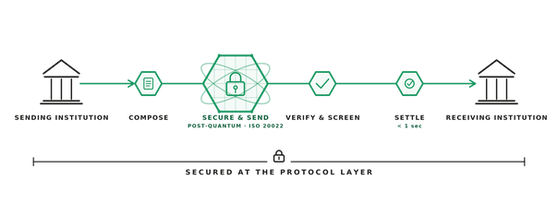
PRODUCTS
Enterprise solutions.
Five interoperable products. Each deployable standalone or as part of a complete stack.
Quantum-resistant security.
Built from genesis block with post-quantum cryptography to safeguard financial data and asset records beyond 2030. No retrofits. No bolted-on protections.
AI-automated compliance.
Real-time transaction screening for AML, sanctions enforcement and market abuse — embedded at the protocol layer rather than added downstream. Native support for ISO 20022, MiFID II, FATF and Sharia frameworks.
Institutional-grade design.
Deterministic throughput, public-permissioned governance and private ledger capabilities. Immutable audit trails. Granular access controls. Designed from inception for regulated environments.
Modular integration.
Deploy as a standalone messaging system, as a tokenization layer, as stablecoin infrastructure — or as a complete stack. Each product is interoperable but independently usable.
DIFFERENTIATORS
Why Quantum Chain.
Four properties that distinguish institutional infrastructure from retrofitted alternatives.
First institutional transactions secured against quantum threats.
2025
Launch & First Clients
Mainnet launch with full quantum-resistant cryptography
Core product suite operational
First partnerships and regulated client integrations
Quantum-secure tokenization goes live
Test deployment of Quantum Dollar (QUSD)
Quantum Chain positioned as alternative settlement layer.
2026
Expansion & Adoption
Expanded QFI/QBP network and tokenization deployments
Regional joint ventures to develop Quantum Banks begin
Q-Stables rollouts in Asia-Pacific, MENA and Africa corridors
Quantum Foundation strategy for regulation
Multi-jurisdictional stablecoin network operational.
2027
System Integration
Q-Metals and Q-FX global network for trade finance
First licensed Quantum Banks operational
QFI/QBP ecosystem surpasses 10 quantum-native projects
Expansion into bonds and securities for new markets
Industry-recognised post-quantum financial infrastructure.
2028+
The QFRS
Quantum-secure alternative to SWIFT and legacy systems
Institutional adoption of Q-Stables for treasury
Over $100 billion in tokenized assets secured
Mass retail adoption through QFI/QBP applications
STRATEGIC ROADMAP
From mainnet to QFRS.
A four-phase trajectory from the launch of quantum-resistant infrastructure to a fully operational Quantum-Resistant Financial System.
ECOSYSTEM
The Quantum Chain ecosystem.
Quantum Chain is the infrastructure layer of a broader system of associated entities, regulated partners and contributing institutions.

REGULATORY ENGAGEMENT
Engaged with regulators globally.
Active engagement across six jurisdictions through sandbox programmes, applications and ongoing dialogue.
01
HTTPQ Pilot
Deploy quantum-secure ISO 20022-compliant messaging in a sandbox connected to your existing systems.
WHAT YOU GET
Sandbox node with full HTTPQ messaging stack
Integration support to existing payment systems
Defined success criteria and pilot scope
02
Qustody Pilot
Evaluate post-quantum cryptographic infrastructure for digital asset custody under your existing regulatory permissions.
WHAT YOU GET
Reference custody architecture and integration kit
HSM and key management integration support
Defined success criteria and pilot scope
03
Tokenization Pilot
Issue and manage tokenized financial instruments in a controlled environment under issuer governance.
WHAT YOU GET
Issuance and lifecycle management toolkit
Compliance metadata templates and policy rules
Defined success criteria and pilot scope
04
Q-Stables Pilot
Deploy infrastructure for fiat-referenced digital value instruments under licensed-issuer governance.
WHAT YOU GET
Mint and burn engine with policy controls
Reserve attestation and reporting framework
Defined success criteria and pilot scope
NEXT STEPS
Start a pilot.
Four pilot tracks. Structured scope. Defined timelines.
DEMO
Custody infrastructure, demonstrated.
Qustody provides the institutional-grade custody layer for digital assets — key management, policy controls and auditable governance, built on post-quantum cryptography. A full walkthrough is on the way.

DOCUMENTATION
Resources.
Documentation, technical references and pilot packs for institutional review.




Speak with our team.
A 30-minute call to discuss your use case, evaluate fit, and outline a path to pilot. No commitment.
Nhận xét
Đăng nhận xét